Starfield
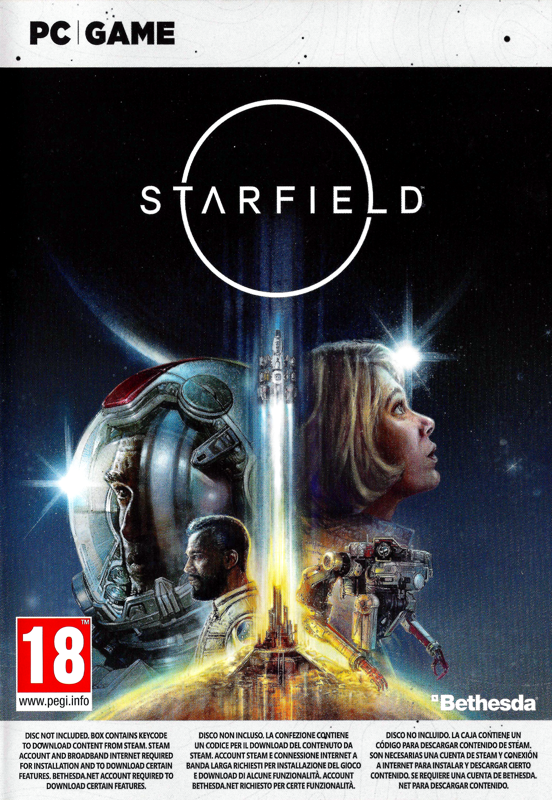
Description
Starfield is a single-player action role-playing game. The story takes place in the mid-24th century, during an age of interstellar exploration and colonization. Humanity has spread across hundreds of star systems, forming settlements and factions that compete for influence, resources, and survival. The player assumes the role of a customizable protagonist who joins Constellation, an organization devoted to exploring the galaxy and uncovering its mysteries. Early in the story, the character comes into contact with strange artifacts that point toward a larger secret behind humanity’s place among the stars.
The narrative unfolds across a mixture of handcrafted and procedurally generated locations, with quests that range from personal storylines to galaxy-spanning conflicts. Factions such as the United Colonies, Freestar Collective, and Ryujin Industries can be allied with or opposed, and choices made during these interactions affect how the player is perceived throughout settled space. While the overarching objective is tied to the mystery of the artifacts, players are free to chart their own course as explorers, mercenaries, traders, or pirates.
Gameplay combines first-person and third-person exploration, ground combat, and space travel. On planetary surfaces, players can use firearms, melee weapons, and jetpacks to fight hostile forces or traverse rugged environments. Shooting mechanics include ballistics, energy weapons, explosives, and stealth options, with enemies ranging from human soldiers to alien wildlife. Combat is supported by skill-based progression that unlocks new abilities and bonuses across categories such as science, social, physical, and technology.
Progression is tied to leveling and skills. Experience points are earned through combat, exploration, and completing quests, allowing the player to unlock and upgrade perks that affect weapon handling, persuasion, crafting, and piloting. Equipment includes customizable spacesuits, helmets, and weapons, many of which can be modified with attachments and upgrades. Inventory management requires balancing weight limits and resource collection, encouraging choices between carrying supplies, loot, or crafting materials.
Space exploration is a central system. Players can pilot and customize ships, upgrading modules such as engines, shields, weapons, and cargo bays. Ships can be purchased, stolen, or modified at shipyards, and are used both for interstellar travel and for real-time space combat. Battles in orbit involve managing power distribution between systems, targeting enemy components, and boarding or disabling hostile vessels. Landing on planets is seamless, transitioning from orbital travel to on-foot exploration.
Settlements and outposts can be built on planets, where players harvest resources, establish supply chains, and recruit crew members. Crafting systems allow research and development of new technologies, equipment upgrades, and consumables. Companions with unique personalities and skills can accompany the protagonist, assist in combat, and react to dialogue decisions. Relationships with companions may deepen depending on player choices.
Dialogue and morality systems shape story outcomes. Conversations use branching dialogue trees where persuasion skills can alter the success of negotiations. Choices influence quest resolutions, faction allegiances, and character reputation across the galaxy. Unlike strictly linear narratives, the open-ended structure allows multiple solutions, from diplomacy to violence or subterfuge, depending on player preference.