UFO 50
Description
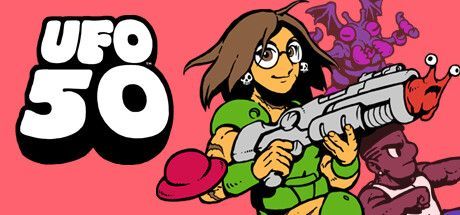
UFO 50 is a single-player and local multiplayer retro-style anthology game. The game is framed as a rediscovered catalog of fifty titles reportedly produced by a fictional 1980s company called UFO Soft. Presented with authentic 8-bit visuals, chiptune music, and simulated boot-up screens, each game appears as its own standalone cartridge complete with a title screen, manual-style lore, and a unique aesthetic. Players can explore each game immediately from the start, shifting between fast arcade-like experiences and deeper genre experiments.
The 50-included titles span a wide range of genres, including platformers, shooters, puzzles, RPG-style adventures, sports, stealth, and strategy. Each game operates within its own ruleset, encouraging players to adapt rapidly. Mechanically, games differ significantly: some focus on high-score runs; others offer character progression, exploration, or strategic depth. About half support local multiplayer in versus or cooperative modes. A metagame encourages completion by unlocking deeper narratives and references across games. Modern conveniences include save points, difficulty modifiers through relics, and seamless switching between titles.
Included Titles:
1. Barbuta is a single-player action platform game. In this medieval-themed metroidvania-like title, players control a slow-moving knight who explores a labyrinthine dungeon filled with traps, enemies, and dead ends. Death is easy in this world - one misstep against a mushroom or bat sends the knight back to the start. The game emphasizes deliberate exploration and incremental mastery of the interconnected map. Mechanically, Barbuta offers tight platforming and simple combat with a sword. The absence of falling damage shifts focus to hazard navigation and environmental puzzle solving. The player's progress is often measured in small gains toward mapping and safely navigating the dungeon.
2. Bug Hunter is a single-player puzzle strategy game. Set on a grid-based battlefield, players assume the role of a bug exterminator tasked with clearing insect infestations before they spread. Strategy lies in choosing optimal movement and attacks while managing a deadline - if eggs hatch, the mission is lost. The game blends turn-based tactics with modular deck-building mechanics. Players collect "modules" (action options) to customize their approach to each level. Balancing offense, defense, and time constraints forms the core challenge.
3. Ninpek is a single-player arcade platform game. In this swift auto-scrolling ninja platformer, players guide a nimble shinobi through a series of perilous levels. While running automatically, the ninja must leap over hazards and dispatch foes with precision timing. Gameplay emphasizes rhythmic movement and rapid reactions, echoing side-scrolling classics like SonSon. Despite its unrelenting pace, levels remain short, requiring minimal time investment per run but rewarding repeat attempts. Ninpek’s challenge comes from memorizing patterns and coordinating jumps under pressure.
4. Paint Chase is a single-player arcade maze game. This title invites players to control a car around a maze, aiming to paint more floor space than AI-controlled competitors - an amalgam of Pac-Man and Splatoon. Movement is simple: turn using directional inputs, with a dedicated brake command. Speed, spatial awareness, and antagonistic obstacle management are key to outpacing rivals.
5. Magic Garden is a single-player puzzle arcade game. This title blends snake-like mechanics with collectible growth. The player maneuvers a creature through a garden, gathering items while avoiding self-collision and environment hazards. As items are collected, the creature grows, constraining movement and requiring route planning to avoid becoming trapped.
6. Mortol is a single-player puzzle platform game. Set in the kingdom of Mortolia, players control citizens tasked with reclaiming their land through ritual powers. Each character can perform Rituals of Arrow (creating a platform), Bomb (explosion), or Stone (barrier), often sacrificing themselves instead of surviving. These mechanics allow traversal and puzzle-solving within interconnected levels. Death is a tool rather than a failure, embedded in the progression structure. Lives are limited, making strategic use of sacrifices essential. Levels include checkpoints, and extra lives are awarded for collecting items or defeating enemies.
7. Velgress is a single-player vertical platform endurance game. Players guide Alpha, a captured space pirate, as she climbs out of a pit filled with disappearing platforms and hazards. The vertical levels auto-degrade beneath her feet, pressing players to ascend rapidly while maintaining precision. Floors are numbered, and the game tracks how high the player has reached, encouraging personal best improvements. Contact with a lethal roller at the bottom ends the run. The climb includes coins for collection, used between attempts to purchase upgrades like magnetized pickups or slower platform decay. Hidden challenges and a secret fourth level become accessible through careful play.
8. Planet Zoldath is a single-player diagonal-down adventure game. Players control an explorer named Pilot, navigating a hostile planet in search of three treasure map pieces to escape. The world includes both friendly and aggressive NPCs. Friendly NPCs can be communicated with using the Translator item to trade for map pieces or other resources, while aggressive NPCs may explode or attack with predictable patterns. Key items - such as the boomerang, nail gun, metamorpher, hazard boots, pulse generator, bombs, and a meat printer - enable traversal, puzzle-solving, and survival. Many mechanics are intentionally opaque, encouraging learning through experimentation. Exploration, item usage, and environmental interaction are central to completing objectives and progressing.
9. Attactics is a single-player grid-based strategy game. This auto-battler unfolds on a grid where players deploy troops on the left side, which march rightward to confront incoming enemies. Strategy lies in unit placement - moving up, down, or backward on the grid - to form effective formations and counter enemy waves. Matches are automatic once units are placed, requiring tactical foresight rather than real-time input. Players must adapt to continuously evolving threats as enemies adjust composition.
10. Devilition is a single-player puzzle strategy game. The game challenges players to arrange demons on a grid so that their placement triggers chain reactions of explosions. Each demon type likely exhibits distinct patterns or effects, making placement tactical. While details on specific mechanics are sparse, the core loop relies on spatial reasoning, planning chain sequences, and managing limited space.
11. Kick Club is a single-player arcade platform game. This single-screen action-platformer blends sports and combat as players kick a soccer ball to defeat enemies scattered across each layout. The ball can bounce off enemies to cause damage or dispatch multiple foes in a chain for higher scores. Letting the ball stay still breaks combos, while timing and positioning matter. Chain reactions reward better item drops, and some stages wrap vertically, forgiving mistakes.
12. Avianos is a single-player strategy game. Players command wings of dinosaur units vying for territory control on a hex grid. Units spawn at the left and march right toward opponent columns. Strategic placement (up, down, or backward) dictates pathing and confrontation. Early in play, mechanics were turn-based, but were replaced with auto-combat to heighten pacing. Resource management and positioning matter as players aim to claim more zones than the computer-controlled adversary.
13. Mooncat is a single-player platform game. In this surreal platformer, players guide a cat across moon landscapes using unconventional controls: the D-pad moves left, face buttons move right, opposite direction makes the cat drop downward, and pressing buttons midair executes a dive bomb. Level themes shift from moon forests to caves, underwater scenes, and fortified areas, each introducing varied hazards and platforming logic. The control layout subverts standard habits, requiring players to consciously adapt to its mechanics.
14. Bushido Ball is a single-player and local multiplayer sports game. This samurai-themed Pong variant involves volleying a ball using sword slices and body blocks. Players choose from several characters, each equipped with unique special moves unlocked through successful volleys. As rallies progress, a special gauge fills, granting access to powerful techniques that can turn the tide. The match escalates in speed over time, demanding quick reflexes and strategic shot placement.
15. Block Koala is a single-player puzzle game, reminiscent of Sokoban. This block-matching titles presents players with a grid where they must clear and arrange blocks to solve increasingly complex puzzles. A key feature is its integrated level creator, which allows players to design and play their own stages. The grid-based logic emphasizes pattern recognition and forward planning, as shapes must be cleared without backing into traps or dead-end layouts.
16. Camouflage is a single-player puzzle and stealth game. Players navigate tile-based levels where the goal is to blend into the environment by switching patterns or colors to match the terrain. Movement must be carefully timed to avoid detection from roaming enemies, whose patrol paths grow increasingly complex. Certain levels demand the player to stay still at the right moment, while others involve switching camouflage on the fly. Each stage is presented as a logic puzzle, with a limited number of moves or disguises available, encouraging efficient problem-solving. Camouflage combines visual pattern recognition with stealth planning.
17. Campanella is a single-player arcade action game focused on exploration. The game unfolds in a dreamlike setting where progress is tied to sound and resonance. Players move through scrolling stages that reveal hidden structures when bells or chimes are struck, altering the landscape and opening new routes. Exploration encourages experimentation, as tonal interactions transform platforms or awaken characters who provide guidance. Progression occurs gradually through discovery, with each new area.
18. Golfaria is a single-player action-platform game with puzzle elements. Set in cavernous, interconnected levels, players advance by striking a golf ball through obstacles, switches, and enemies. The ball acts as both a weapon and a traversal tool, knocking open hidden passages or activating platforms when directed correctly. Movement combines standard platforming with careful lining up of shots, giving the experience a hybrid feel between a Metroidvania and a physics-based golf puzzler. Progression unlocks new areas and challenges, rewarding accuracy and timing as much as exploration. Golfaria’s novelty lies in its fusion of sports mechanics with dungeon-like progression.
19. The Big Bell Race is a single-player time-based platform game. Players must reach a large bell at the end of each stage before the clock expires. Levels are built around quick reflexes, requiring players to optimize routes, chain jumps, and exploit shortcuts. Hazards, such as disappearing floors or moving obstacles, challenge timing and consistency. Bonus rewards are granted for faster completion.
20. Warp Tank is a single-player vehicular action and puzzle game. Players control a tank equipped with short-range warp technology, allowing it to teleport across obstacles or reposition quickly in combat. Levels mix shooting engagements with environmental puzzles, such as warping past barriers, evading traps, or ambushing enemy turrets. Limited warp energy requires careful management, with pickups or cooldowns dictating use. Combat remains straightforward, but puzzles demand creative application of movement and timing.
21. Waldorf’s Journey is a single-player narrative-driven platform game. Players guide Waldorf through side-scrolling environments that emphasize storytelling as much as platforming. Each stage is built around interactions with characters who present dialogue, choices, or tasks that expand the overarching narrative. Platforming challenges are generally accessible, serving as transitions between story events rather than obstacles on their own. Collectibles tied to memories or objects provide background details.
22. Porgy is a single-player action game with a focus on underwater exploration. Set in a sprawling oceanic labyrinth, players navigate interconnected environments reminiscent of Metroidvania design. Progression is tied to acquiring new abilities such as enhanced swimming speed, projectile attacks, or specialized diving gear that unlocks deeper zones. Hostile creatures patrol corridors, requiring strategic movement and attack timing. Exploration rewards discovery, with hidden routes, upgrades, and lore scattered throughout the environment.
23. Onion Delivery is a single-player arcade action and time-management game. Players control a courier tasked with collecting and delivering onions under strict time limits. Each level consists of a maze-like city layout filled with traffic, obstacles, and hazards. Deliveries must be completed in sequence, and speed determines the overall rating. Controls emphasize efficiency, requiring players to learn shortcuts and anticipate patterns. As stages advance, more onions and destinations appear simultaneously, increasing complexity.
24. Caramel is a single-player vertical shoot-'em-up game. Players pilot a craft ascending through enemy-filled skies, firing continuously while dodging projectile patterns. Power-ups enhance weapon spread, speed, or defense, but enemies increase in both volume and aggression as stages progress. Boss encounters punctuate levels with unique attack patterns that require memorization and precision dodging. Scoring systems reward chaining enemy defeats and minimizing damage taken.
25. Party House is a strategy and management game. Players manage a social venue where guests arrive with varying needs and personalities. The objective is to balance activities, resources, and space to maximize satisfaction. Mechanics include assigning guests to games, replenishing supplies, and resolving conflicts before they escalate. The experience is lighthearted but requires resource prioritization and multitasking under pressure. Difficulty increases as guest numbers grow and demands overlap.
26. Hot Foot is a single-player and multiplayer sports action game. Two teams face off in dodgeball-inspired matches where players throw, catch, and dodge projectiles. Court layouts vary, introducing barriers, hazards, or bounce mechanics that alter tactics. Timing is crucial: catching restores possession while missed opportunities leave players vulnerable. Matches are fast-paced, with momentum swinging quickly as teams eliminate opponents.
27. Divers is a single-player role-playing game with exploration elements. Set in a vast underwater labyrinth, the game emphasizes slow-paced progression and atmospheric discovery. Players command a team of divers equipped with limited oxygen and tools, forcing careful planning for each excursion. Exploration reveals hostile creatures and environmental hazards, with combat handled in turn-based sequences. Progression is tied to gathering resources, upgrading gear, and unlocking deeper sections of the labyrinth.
28. Rail Heist is a single-player stealth and action platform game. Players infiltrate moving trains to steal cargo while avoiding guards and obstacles. Each stage is built around stealth mechanics, with players using shadows, disguises, or timing to slip past patrols. Combat is possible but risky, making silent movement the preferred option. Objectives vary between stealing valuables, detaching train cars, or escaping at the right moment. Difficulty escalates with faster-moving trains and denser guard patrols.
29. Vainger is a single-player action Metroidvania game with gravity-based mechanics. Levels are interconnected but progression depends on the ability to flip gravity. Players can invert orientation at will, walking on ceilings to bypass obstacles, solve puzzles, and evade enemies. Combat is light, relying on positioning rather than direct strength, with hazards serving as the primary challenge. Exploration gradually unlocks new routes, rewarding creative use of gravity shifts.
30. Rock On! Island is a single-player strategy and tower defense game. Players defend a prehistoric island settlement from waves of hostile creatures by placing defensive units and environmental traps. Towers include stone throwers, spearmen, and flame-based devices, each suited for particular enemy types. Resource collection and placement timing determine survival, as stronger enemies emerge with each wave. Levels escalate in difficulty, requiring upgrades and more efficient defenses.
31. Pingolf is a single-player sports puzzle game with pinball mechanics. Each stage tasks players with guiding a golf ball to a hole positioned within elaborate pinball-style boards. Flippers, bumpers, ramps, and targets replace traditional fairways, forcing players to time shots carefully and use environmental features to their advantage. Obstacles such as traps or moving hazards require precision and planning, while bonus scoring comes from hitting certain bumpers or clearing optional routes. Levels vary from short, direct puzzles to large multi-screen arenas, blending golf rules with the unpredictable physics of pinball tables.
32. Mortol II is a single-player puzzle platform game and sequel to Mortol. Players once again progress through dangerous side-scrolling stages filled with enemies and traps. Unlike its predecessor, Mortol II introduces a “corpse mechanic” where fallen bodies remain on the stage, altering terrain and occasionally becoming platforms or hazards. This feature allows players to use past failures creatively, building makeshift routes or blocking dangers. Standard platforming challenges are supplemented with enemy waves and puzzles that require manipulating corpses strategically.
33. Fist Hell is a single-player beat-'em-up action game. Set in a world overrun by undead and demonic enemies, the game emphasizes hand-to-hand combat with limited weapons. Players progress through side-scrolling stages filled with aggressive foes, using punches, grapples, and combos to survive. Enemy swarms require crowd control, with players chaining moves to clear groups efficiently. Health pickups and temporary buffs appear intermittently, rewarding aggressive play. Boss encounters punctuate levels with unique attack patterns. Fist Hell delivers linear, stage-based combat against supernatural opponents in arcade fashion.
34. Overbold is a single-player arcade-style shooter, horde-survival game. The game focuses on short but risky sessions where players attempt to maximize score while avoiding sudden failure. Levels feature randomized hazards, requiring reflexes and bold movement through increasingly dangerous conditions. The risk-reward loop is central: players can push forward for higher points but risk losing progress instantly if hit.
35. Campanella 2 is a single-player action platformer game with a heavy focus on exploring with roguelike elements. As a sequel to Campanella, players control Isabell, who searches for her missing brother across randomly generated levels. Gameplay alternates between piloting the Campanella ship and side-scrolling platforming. The ship requires fuel and coins to survive, with failure ending the run immediately. The game emphasizes resource management, careful navigation, and replayable progression through branching routes.
36. Hyper Contender is a multiplayer platform fighting game. Designed for short, high-stakes matches, the game pits players against one another in reflex-based 1:1 duels. Five rings appear on the stage over time, and each hit causes the player to drop a ring. Characters face off in enclosed arenas with victory determined by who holds the most rings by the end. Players can choose from eight playable fighters, each with their own unique abilities.
37. Valbrace is a single-player, dungeon-crawler role-playing game. Players explore interconnected areas, facing real-time battles against enemies while gathering equipment and resources. Character progression occurs through experience points and ability unlocks, allowing specialization in combat roles. Magic and spellcasting can be learned to aid in adventuring and combat. The game saves at every new floor reached allowing for continuous play.
38. Rakshasa is a single-player platform action game. Players control Jangi, who ventures into demon-infested levels to avenge his village. He has only one life per run and must face waves of supernatural foes. If he takes damage while accompanied by the “One‑Eyed Bat” (a single-use shield), the bat sacrifices itself by raising a white flag before vanishing. Levels involve learning enemy patterns and navigating hazards with pixel-perfect timing. Progress relies on memorization, risk management, and precision across tightly designed platforming stages.
39. Star Waspir is a single-player classic vertical shoot-’em-up game. Players pilot one of three uniquely colored ships, each with distinct abilities. As enemies are defeated, they drop E and G letters. Arranging the letters like "EGG", "EEE", "GGG", "GEE", etc. provides the player with various powerups, with some combinations doing nothing. Waves follow predictable attack patterns, and bosses mark each stage’s end.
40. Grimstone is a single-player Wild West-themed RPG adventure game. Players assemble a posse of four characters to traverse the land of Lone Star, which has been dragged into Hell. Combat uses timing-based action commands - perfect hits cannot miss. The setting blends Western motifs with demonic fantasy, with traveling from town to town, completing quests, and recruiting party members.
41. Lords of Diskonia is a single-player fantasy action and strategy game with psuedo-tactical elements. Players move through the land of Diskonia, battling rival lords and armies for control of territories. The combat system emphasizes positioning on a battlefield grid where warriors, monsters, and leaders clash in quick encounters with units designed as tokens/disks. Units have varying damage and health that is tied to the size of their disk. Players fling/launch disks around the map in attempt to strategically strike opponents' disks on the map. Victory requires eliminating all of the opponents units/disks.
42. Night Manor is a single-player horror, point-and-click adventure game. Players explore a large mansion at night, searching for an escape while being stalked by unseen terrors. Movement is limited to side-view rooms connected by locked doors and secret passages. Light sources must be found to reveal clues and avoid hazards in the dark. A killer patrol the halls, and contact means instant death. Survival depends on running/hiding from the killer and solving puzzles to reach the manor’s end.
43. Elfazar’s Hat is a single-player run-and-gun game. A rabbit protagonist and a pigeon ally rebel against the magician Elfazar, crossing hostile stages to free captured friends. Levels conclude with boss encounters, and performance is tracked across a limited-credit structure that can influence the ending. Combat centers on movement, dashing, and temporary shields. Power growth comes from collectible cards that drop during play: collecting multiples of the same suit upgrades shots or utility, with stronger effects granted by matching sets. Between set pieces, bonus mazes offer golden tickets used to secure advantages for later segments.
44. Pilot Quest is a single-player top-down action game with idle progression. Set on the planet Zoldath, the player explores an overworld and short dungeons to recover parts needed to repair the Campanella. Expeditions are framed by a base loop where striking a crystal generates moon drops that can be refined into higher-tier resources, which in turn unlock upgrades and new routes. Play alternates between resource gathering and timed forays. Meat functions as expedition time, granting a set window to leave base, explore, and return, while taking damage reduces the remaining time before the player must return.
45. Mini & Max is a single-player open-world, Metroidvania platformer game. The player controls Mini, accompanied by her dog Max, and can shrink or grow to traverse a single room that contains multiple layered play spaces. At full size the room acts as rapid traversal, while shrinking allows entry into plants, pipes, and other small environments that connect into a non-linear world. Progression centers on exploration, NPC quests, and permanent upgrades that expand movement and interactions, including higher jumps, riding insects, carrying and throwing objects, and unlocking new routes.
46. Combatants is a single-player real-time strategy game. The player commands an army of ants in territorial battles against rival colonies. Units are directed across the battlefield to attack enemies, capture ground, and defend the queen. Engagements take place in open arenas where large groups of ants converge, creating skirmishes. Resource management is minimal, with the emphasis placed on issuing commands and positioning swarms effectively. Progress is measured by defeating enemy colonies and advancing through increasingly difficult scenarios.
47. Quibble Race is a single-player gambling and strategy game. Players participate in sci‑fi horse-like races by betting on “Quibbles,” creatures racing on a track. Between races, they can gain an edge through sponsorships, gathering performance data, or sabotaging opponents. Successful bets yield different outcomes and payouts. Some Quibbles are guarded, making interference risky and subject to penalties if caught. Money is the primary resource, but running out does not end the game - you can always borrow more to pay off later.
48. Seaside Drive is a single-player horizontal “shoot-’em-up” driving game. Players control a weaponized red car traveling along a coastal highway over a full day cycle. The vehicle automatically moves forward, and the only control is vertical movement up and down the road to aim its guns at the air and land threats that appear from above or ahead. Drifting increases the car’s weapon power. Players face airborne enemies like jellyfish, floating skulls, and fish, and occasionally ground-based foes. Bonus levels resembling Breakout-style block-breaking appear for extra lives and high scores if the player completes a stage without losing.
49. Campanella 3 is a single-player rail-shooter action game. In this finale of the Campanella trilogy, players pilot the Campanella saucer through deep space, engaging enemies in a pseudo-3D rail shooter manner. Enemies approach from various angles, and the player must quickly switch firing modes to respond. Each wave ends with a performance grade, with bonus stages such as balloon‑shooting segments. Bosses exhibit visual cues when damaged, become more aggressive as they lose health.
50. Cyber Owls is a single-player multi-genre game. As the culmination of UFO 50, it incorporates mechanics from several earlier titles, presenting a hybrid experience. Stages shift between platforming, shooting, vehicular action, stealth, and brawling sequences, each drawing inspiration from other entries in the collection. Players control owl-like figures with cybernetic enhancements, navigating diverse environments that require adapting quickly to changing gameplay styles. The design serves both as a final challenge and as a retrospective of mechanics introduced across the compilation.
The collection offers a snapshot of imagined video game history, where each title reflects a distinct idea or innovation - together forming a curated, exploratory journey.