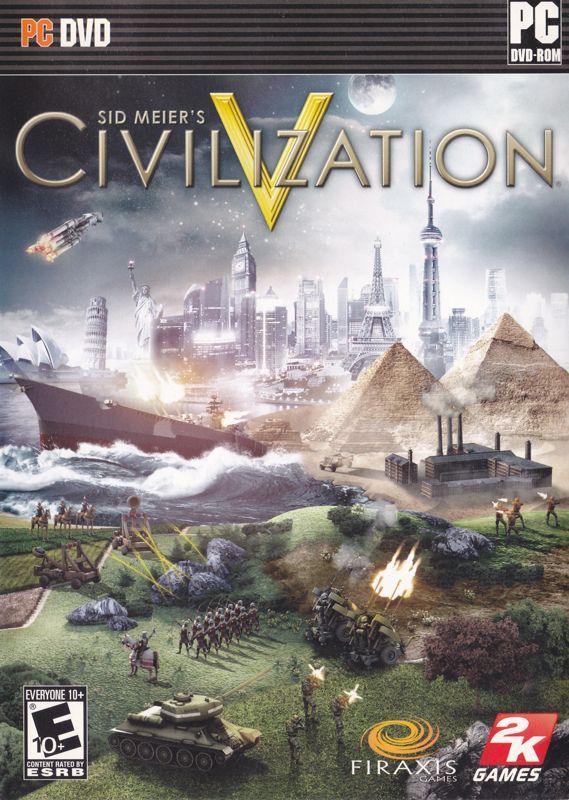
Sid Meier's Civilization V
Description
Sid Meier’s Civilization V is a single-player and multiplayer turn-based 4X strategy game. As the ruler of a fledgling nation, the player begins with a lone settler and a warrior in an unexplored world. From this starting point the objective is to expand, discover, negotiate, and if necessary fight, guiding the civilization across eras while pursuing one of several paths to long-term dominance. Rival leaders develop their own empires at the same time, so exploration, diplomacy, culture, science, and military planning must be balanced to reach victory.
Play takes place on a hexagonal world map that replaces the square tiles of earlier entries. Each hex represents terrain such as plains, hills, forests, or coast, and provides yields of food, production, and gold that determine city growth and construction speed. Fog of war hides the map until units explore it. Strategic and luxury resources appear on specific tiles. Strategic resources such as iron and oil gate the production of advanced units, while luxury resources increase empire happiness, which affects growth and productivity across all cities.
Cities are the core of the empire. Founding or conquering a city claims surrounding hexes, then citizens can be assigned to work those tiles or specialists inside buildings. Players queue buildings and wonders, train military and civilian units, and purchase items with gold. Workers improve terrain by constructing farms, mines, roads, and other infrastructure, and later repair damage from war. Scientific progress follows a technology tree that unlocks new buildings, units, and abilities from the ancient era to the future. Cultural growth unlocks social policies. Policies are purchased with accumulated culture and are organized into themed trees, granting bonuses such as faster border expansion, improved happiness, or economic and military benefits.
Combat uses a one-unit-per-tile rule that emphasizes positioning. Melee units must enter an enemy’s hex to capture or destroy it, while ranged units fire from adjacent or greater distance. Flanking, terrain height, and zone of control influence outcomes. Naval forces are divided into melee and ranged classes and can capture coastal cities. Cities possess hit points and a bombardment attack, so sieges require combined arms and careful movement. Great People appear from specialist work or notable accomplishments and provide powerful one-time effects, for example constructing a landmark improvement or triggering a Golden Age.
Diplomacy includes direct treaties with rival civilizations and independent city-states that occupy the map as minor powers. Influence with city-states can be raised through quests, gifts, or protection promises, which grants benefits such as unique luxuries, military units, or cultural output. Players can sign open borders, defensive pacts, and research agreements, trade resources and gold, and manage grievances that arise from actions like surprise wars or territorial disputes. Victory conditions include military conquest of all original capitals, reaching the end of the technology tree and launching a space project, achieving cultural preeminence through social policy development, or earning a diplomatic win via global voting in scenarios that support it.
Multiplayer supports simultaneous turns and a variety of match setups across custom maps or scenarios. Mod support allows users to add maps, rules variants, and interface enhancements.