Tales of Destiny
Description
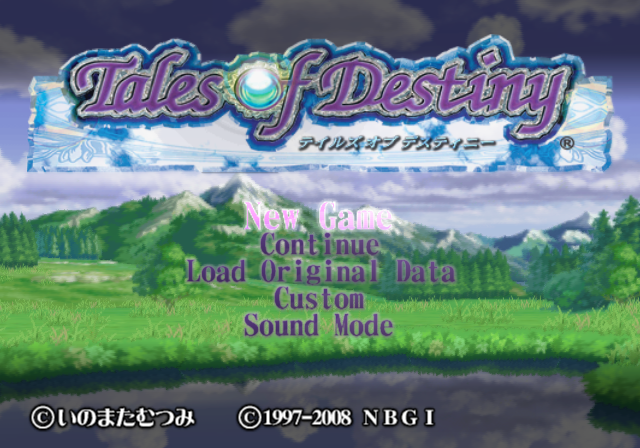
The PlayStation 2 remake of Tales of Destiny retells the story of the original game, making numerous minor changes while adhering to the same pivotal moments in the story, effectively replacing the original game canonically. It reused some animated FMVs from the original game (albeit remastered in higher resolution) and the same recording of the theme song "Yume de Aru you ni", everything else has been remade from scratch.
The combat system in this remake marks a sharp departure not only from the original game, but also from all preceding games in the Tales series series. Instead of free normal attacks and consuming the finite TP bar for artes, both normal attacks and artes now draw from the same renewable CC (Chain Capacity) bar. Normal attacks consume 1CC, artes consume 2CC or more. Each character has a Minimum and Maximum CC amount, their CC bar starts at the Minimum amount when they enter battles. Everytime you consume CC, the CC bar restores after a delay that follows the last action taken, and everytime this restoration happens, the CC bar length is extended by 1CC. At the Maximum CC amount, triggering this will loop the CC bar length back to the Minimum amount. Every CC-consuming action which takes place before that restoration triggers counts as part of a combo. Backsteps and dashing also consume 1CC. Jumping is a free action, but double jumping consumes 1CC. You can also manually trigger a CC bar extension with a charge action.
Another notable addition to the combat of Destiny PS2 is a separate weakness system in addition to the elemental weakness system. Each enemy is designated a sequence of attacks called "Definite Strike" that can be done by only one character. Landing all attacks in this Definite Strike unguarded will result in a guaranteed stun and double item drop rate. Definite Strike is only effective once per enemy per battle.
Numerous changes have also been done to Destiny PS2 outside of combat. Swordian Master party members now can only equip their respective Swordians (aside from limitations imposed by the story), and the Swordians themselves are now a new progression system unique to Swordian Masters. Each Swordian has a pool of Device Point (which expands on leveling up) to allocate to a selection of nodes on a circle that provide passive stat increases and effects. Engaging in combat while having these nodes allocated will increase their proficiency percentage. At 100% proficiency, the DP cost of a node is reduced by 20% and nodes from outer rings on the circle will be unlocked.
Lens are now separated into 5 different grades. This was done in service of a new equipment upgrade system called "Rerise". All armors, accessories and non-Swordian weapons can be upgraded by consuming Lens, making Rerise the primary way to gain equipment stats and newer equipment act as side grades to existing ones rather than as upgrades by themselves. Rerising typically offers 2 to 4 upgrade paths and consumes higher-grade Lens the higher Rerise level a piece of equipment is on.
The food sack has also seen a major overhaul. Instead of passively healing your party outside of battle, the food sack now triggers a heal per battle on certain conditions. These conditions are represented by "food straps" equipped to the food sack. The food sack's capacity grows automatically after each trigger. You can no longer consume food on the field to refill the sack. Instead, it can only be refilled by grocer merchants in towns and special spots.
Other changes from the original:
- All party members that required re-recruitment during Arc 2 of the original game now rejoin your party automatically. No selection needed, as your party size is no longer limited at 6 members.
- A new optional party member: Lilith. Her recruitment quest is available in Arc 2.
- Replacing the "Active Party Window" of the original game (where party members start to talk to each other if you idle long enough on the world map) is the "Emotional Card Chat" system, still providing narrative flavors and reminders of your next objective via optional character conversations, but now can be manually activated anywhere and each chat is more explicitly labeled into one of 3 types: "Navigational" for objective-reminding chats, "Free" for narrative flavor chats and "Rare" for chats that trigger on certain conditions. Characters are animated in portrait cards in these chats, including the Swordians, who are drawn not only as their physical forms but also as their original human forms.
- Firing the the Sorcerer's Ring is now a free action (doesn't consume Lens like the original).
- Your Gald and Lens are no longer confiscated at the end of Arc 1.
- The 5th Swordian can now be used immediately upon acquisition.
- A New Game+ feature has been added, allowing you to carry over books data, titles, mastery progress for food straps and artes and a selection of special effects for the next play through, such as Infinity Movement (movement actions cost no CC), Float Gravity (lower gravity for both allies and enemies) or Survival Mode (significanly reduce both damage and max HP).
- Post-game content such as a new NPC that lets you view FMVs, a stronger version of the final boss and a post-game dungeon.